
Your Mali at a Crossroads: Analysing the Current Challenge to the Junta
Executive Summary
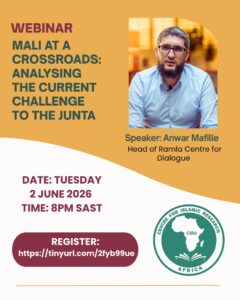
This report details the proceedings of the Centre for Islamic Research - Africa (CIRA) webinar held on 2 June 2026, examining the deteriorating political, security and humanitarian situation in Mali and the wider Sahel region. The guest speaker was Anwar Mafille, head of the Ramla Centre for Dialogue.
The webinar focused on the historical roots of Mali's conflict, the country's long-standing ethnic and regional divisions, the rise of armed movements, successive military interventions, the emergence of Jama'at Nusrat al-Islam wal-Muslimin (JNIM) and the growing challenge posed to the Malian military junta.
Attention was given to the April 2026 offensive involving JNIM and the Azawad Liberation Front (FLA), which significantly altered the military power balance in the country. The offensive demonstrated the ability of non-state armed groups to operate beyond northern Mali and directly targtet areas surrounding Bamako (the capital) and other strategically important locations. The regime was described as severely weakened, while Russian military support has failed to decisively defeat the insurgency.
The discussion emphasised that Mali's crisis cannot be understood solely through a counter-terrorism framework. The conflict is deeply connected to decades of post-colonial marginalisation, unresolved Tuareg demands, ethnic discrimination, weak governance, failed peace agreements and the concentration of political and economic power in the south. The humanitarian consequences are severe. The webinar highlighted large-scale displacement, widespread poverty, acute child malnutrition and limited international attention to the crisis.
It further examined the changing role of foreign actors. France's influence has declined substantially following the withdrawal of French and UN forces, while Russia has become the principal external security partner of the military junta. However, Russian-linked forces have themselves been accused of serious human rights violations.
A significant conclusion is that a purely military solution is unlikely to resolve the conflict. Despite the involvement of groups classified as “terrorist organisations”, the discussion identified existing openings for dialogue, including local negotiations involving religious leaders, political actors and armed groups. Mali stands at a critical crossroads. The weakening of the junta, the growing strength of JNIM and the Azawad Liberation Front and the possibility of further territorial expansion by these groups make dialogue, reconciliation and locally driven political engagement increasingly important.
Introduction
Mali’s deepening political, military and humanitarian crisis reflects a complex interaction of historical marginalisation, armed insurgency, contested state authority and shifting foreign involvement. Drawing on the CIRA webinar “Mali at a Crossroads”, this report examines the conflict’s origins, the changing balance of power following the April 2026 offensive, the tactical co-operation between JNIM and the Azawad Liberation Front, and the prospects for an inclusive political settlement.
2. Background: Historical Roots of the Malian Conflict
Post-Colonial State Formation
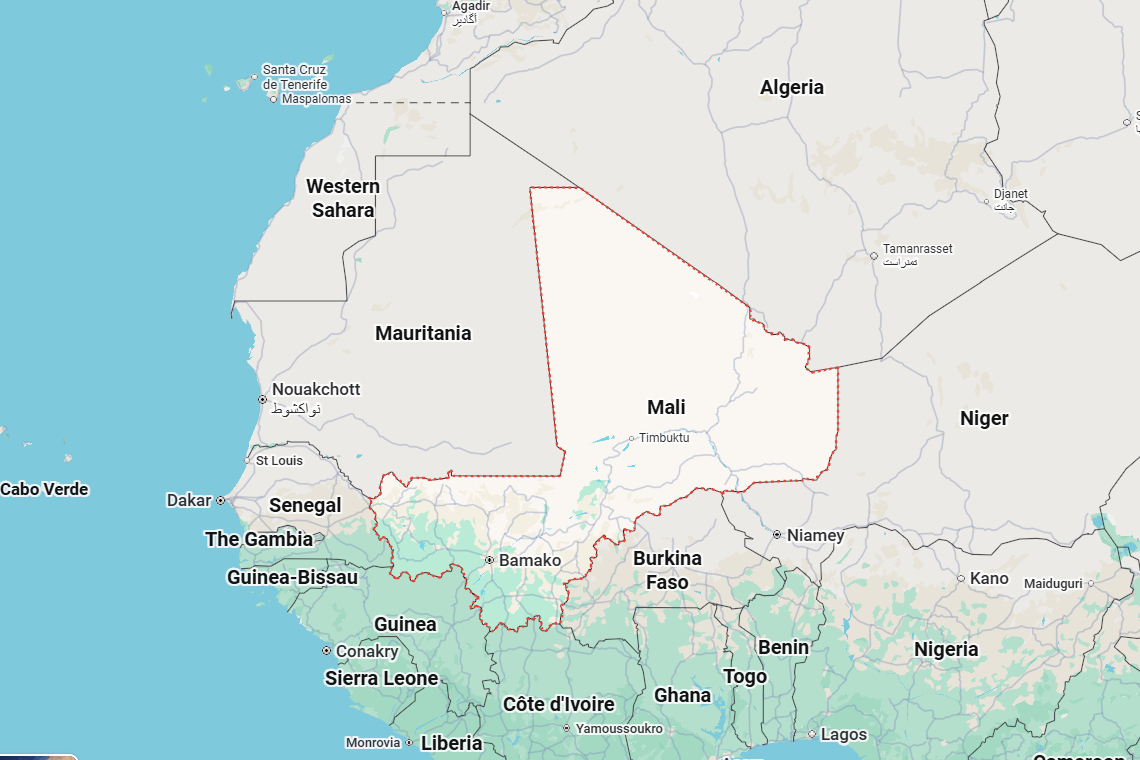
Anwar Mafille (Ramla Centre for Dialogue) emphasised that the current crisis cannot be understood without examining Mali's history and the wider Sahel. Mali is an ethnically diverse country, with Tuareg, Arab and Berber communities concentrated in the north, Fulani populations in central regions, and Bambara and other communities predominantly in the south.
The northern region is closely associated with Azawad, traditionally understood as the homeland of the Tuareg people. Tuareg communities extend across Mali's borders into Niger, Algeria, Libya and Burkina Faso.
The region's current political divisions were reinforced by colonial borders. French colonial rule concentrated infrastructure and development in the more fertile south while largely neglecting the northern regions populated by nomadic Tuareg, Arabs and other communities.
Following independence, political and military power remained heavily centralised in Bamako. Bambara culture and language became an important component of national identity, while many northern populations increasingly felt excluded from the political and economic life of the country. Successive governments systematically under-invested in northern Mali, resulting in severe shortages of roads, schools, hospitals and economic opportunities.
Furthermore, the webinar highlighted allegations of racial profiling, harassment and discrimination against Tuareg and Arab communities. Human-rights violations attributed to state forces included extrajudicial killings, torture, poisoning of wells and collective punishment. These grievances contributed to the emergence of successive Tuareg rebellions.
The Tuareg Rebellion and the Question of Azawad
Tuareg demands for greater autonomy and independence intensified following French withdrawal from Mali. In 1962, the first major post-independence Tuareg rebellion occurred. The uprising was suppressed, resulting in civilian displacement and deepening resentment. Further instability was caused by severe droughts that devastated livestock and undermined the traditional nomadic economy.
In 1990, another major Tuareg uprising occurred, involving groups including the Popular Movement for the Liberation of Azawad. Iyad Ag Ghali emerged as an important figure during this period. A peace agreement was eventually reached in 1995, although violence and political tensions continued.
In 2012, a broad coalition of armed groups rapidly seized control of large parts of northern Mali. These included:
Ansar Dine, led by Iyad Ag Ghali;
Al-Qaeda in the Islamic Maghreb (AQIM);
Movement for Oneness and Jihad in West Africa; and
the National Movement for the Liberation of Azawad (MNLA).
The MNLA was largely composed of Tuareg fighters, including individuals who had previously served in Libya under Muammar Gaddafi and returned to Mali following his fall. Although the groups initially co-operated, the coalition quickly fractured over competing political and ideological objectives. The MNLA sought a secular Tuareg state, while Islamist groups advocated Islamic governance and the implementation of Shari’ah. The resulting conflict between the factions ultimately led Islamist groups to expel the MNLA from much of the territory it had controlled.
French Military Intervention
The expansion of armed groups prompted France to intervene militarily. It deployed approximately 4 500 soldiers, while approximately 14 000 UN personnel and troops from neighboring countries also became involved. Although the intervention pushed insurgents out of major northern cities, it did not eliminate the underlying insurgency. Instead, armed groups expanded into central Mali and eventually carried out attacks further south, including around Bamako. The emergence of Katiba Macina under Amadou Koufa further expanded the conflict. Essentially, the French intervention contributed to heightened ethnic tensions. Government-backed self-defense militias were accused of committing massacres and other abuses, particularly against the Fulani communities.
The Algiers Accord and the Failure of the Peace Process
In 2015, negotiations facilitated by Algeria resulted in the Algiers Accord. Elements of the original Tuareg rebellion, particularly the MNLA, participated in the negotiations. However, some of the most significant armed groups, including Iyad Ag Ghali's movement and al-Qaeda-linked organisations, were excluded. The agreement offered greater autonomy to the Tuareg regions in exchange for disarmament. However, the agreement ultimately collapsed. The central government subsequently labelled parts of the movement as “terrorist”, contributing to renewed alignment between previously competing groups. This failure demonstrated the limitations of peace processes that exclude important armed and political actors.
Emergence of Jama'at Nusrat al-Islam wal-Muslimin (JNIM)
In 2017, several armed groups merged to form Jama'at Nusrat al-Islam wal-Muslimin (JNIM), meaning the “Group for the Support of Islam and Muslims”. JNIM pledged allegiance to al-Qaeda and was led by Iyad Ag Ghali, who had previously been an important figure in the Tuareg nationalist movement. JNIM's growth was facilitated by several factors such as:
French military intervention;
corruption within the central government;
discrimination against northern and central communities;
weak state institutions;
local grievances, and
demands for Islamic governance.
Importantly, the speaker noted that JNIM had expressed openness to negotiations as early as 2019, on condition that France withdraws from Mali.
Military Coup and the Shift Towards Russia
In 2020, Mali experienced another military coup led by Colonel Assimi Goïta. The junta promised to restore security and end the country's prolonged crisis. However, relations with France deteriorated sharply following the coup. By 2021, French troops and the United Nations were asked to leave Mali. The junta subsequently shifted towards Russia and entered into security arrangements involving Russian private military personnel associated with the Wagner Group. The webinar contrasted the two relationships. France was perceived as imposing conditions relating to democracy and human rights, while Russia offered military assistance without the same political conditions. However, Russian-linked forces were accused of massacres and other serious abuses, which further alienated local communities and potentially strengthened support for JNIM.
3. April 2026 Offensive: A Major Shift in the Conflict
The webinar identified the April 2026 offensive as a major turning point in the Malian conflict. JNIM launched an unprecedented nationwide assault reaching beyond traditional areas of insurgent activity. The attacks affected Kidal, Gao, Bamako, Kati and areas further south. The offensive demonstrated the insurgents' ability to project power across a much wider geographical area. The Minister of Defence was killed in the attack, the head of domestic intelligence was severely injured, and President Assimi Goïta disappeared from public view for several days. Most significantly, the regime lost control of Kidal, an important city in the traditional Tuareg homeland. The Russian Africa Corps, which had replaced Wagner, together with Malian forces, were reportedly forced to negotiate a retreat with JNIM. Hundreds of regime soldiers were subsequently captured and later released.
One of the most significant developments in the conflict was the tactical partnership between JNIM and the Azawad Liberation Front (FLA). The two groups had previously been rivals and had clashed as recently as 2024. Later that year, they signed a non-aggression pact which established a framework for co-operation. Under this arrangement, the FLA reportedly moderated some of its previous secular demands and accepted the possibility of Shari’ah governance, provided it would not be implemented as harshly as during the 2012 period. The two movements also agreed on mechanisms for selecting Islamic judges and establishing mutually accepted administrative arrangements in territories they control. The alliance therefore represents more than a temporary battlefield arrangement. It demonstrates an attempt by previously competing movements to avoid the internal divisions that undermined the 2012 rebellion.
JNIM has increasingly used economic pressure alongside conventional military operations. The blockade of fuel trucks and other essential supplies entering Bamako is an important strategic development. Rather than relying solely on direct attacks, JNIM has demonstrated its ability to exert pressure on the capital by disrupting essential supplies, which demonstrates the strength of less directly violent forms of pressure on the junta. An important aspect of the strategy was JNIM's reported willingness to allow medicines and medical equipment to enter after residents appealed to the group. This was presented as part of an effort to gain legitimacy and support among communities, including in southern Mali.
The webinar concluded that the current balance of power does not favour the Malian government. Mali, Burkina Faso and Niger were described as heavily dependent on external security support. By contrast, JNIM and the FLA have developed strong local networks and recruited thousands of fighters. The April 2026 offensive demonstrated their capacity to challenge the junta on multiple fronts and to threaten areas previously considered relatively secure. The ability of JNIM to negotiate the withdrawal of Russian-linked forces during the offensive was identified as particularly significant.
4. Community-Level Impact
The conflict is experienced differently across Mali. In the south, many communities perceive the armed groups primarily through the framework of terrorism, separatism and attacks against the state. In northern Mali, however, the conflict is often viewed as a struggle for liberation, justice and greater political recognition. Some northern communities also support Islamic governance and a political system that recognises Mali's ethnic diversity.
The webinar highlighted severe violence against civilians, including massacres attributed to militias, government forces and Wagner-linked forces. The Fulani communities were identified as particularly affected. These divergent perceptions demonstrate why a purely military or counterterrorism approach risks overlooking the political and social foundations of the conflict.
The humanitarian consequences of the conflict are substantial, and the humanitarian crisis receives considerably less international attention than conflicts elsewhere in Africa. These are:
approximately 40 000 internally displaced people;
more than 100 000 people who have fled across borders into neighboring countries, particularly Mauritania and Algeria;
widespread poverty;
malnutrition;
more than 1.5 million children under five suffer from acute malnutrition, and
recurring epidemics.
This lack of visibility risks worsening the humanitarian consequences and reducing pressure on international actors to respond.
There are identifiable political voices within Mali that support dialogue, although these voices were described as isolated and subject to pressure from the junta. The armed groups remain the most powerful opposition actors because of their military capacity and territorial influence. This highlights the difficulty of separating Mali's political opposition from its armed conflict. Any future settlement would likely have to engage both formal political actors and armed movements with significant influence on the ground.
The webinar identified poor documentation of human rights violations as a major weakness in international understanding of the crisis in the Sahel. Despite the conflict lasting more than a decade, systematic documentation of victims and abuses remains limited. Existing documentation often comes from local sources and receives little attention internationally. The speaker argued that the dangers associated with documenting abuse should not become a reason to avoid scrutiny. A meaningful future peace process would therefore need to address accountability for violations committed by all sides.
5. Regional and External Actors
Russia has emerged as the principal external security actor following France's withdrawal. However, the webinar noted that Russian involvement is relatively limited and is primarily aimed at maintaining the military junta rather than completely defeating JNIM. The presentation suggested that Russia's involvement has not solved Mali's security crisis.
France has lost much of its traditional influence in the Sahel. Its policy towards JNIM remains strongly focused on counter-terrorism. France has classified JNIM as a terrorist organization, pursued its leaders and generally opposed negotiations with the group. The webinar nevertheless raised the possibility that changing circumstances could eventually force Western governments to reconsider their approach.
Mali's conflict has significant regional dimensions because Tuareg and other communities extend across several national borders. The main regional actors identified included Mali, Burkina Faso, Niger, Algeria and Libya. The emergence of the Alliance of Sahel States was discussed as part of the broader political realignment following military coups and the deterioration of relations with France.
6. Decolonisation and the Sahel
The webinar examined the widespread perception that the rise of military governments represents a new phase of African decolonisation. The expulsion of France from Mali and neighboring Sahel countries has been welcomed by many people across the Global South. However, the speaker cautioned against describing the process simply as decolonisation. While French influence has declined substantially in West Africa, Mali's dependence on Russia for security assistance means that foreign military dependence has not disappeared. The webinar further noted that some northern and central communities perceive the military juntas as reproducing earlier patterns of discrimination, corruption and violence, while replacing one external security actor with another.
7. Prospects for Dialogue and Negotiation
Despite the military nature of the conflict, the webinar identified genuine possibilities for dialogue. JNIM had previously expressed willingness to negotiate, while some actors within the Malian government have also indicated openness to negotiations. Religious clerics and political actors have participated in or supported efforts relating to dialogue and prisoner releases. The primary obstacle identified was the central government's unwillingness to recognise the legitimacy of the Azawad movement.
The different objectives of the two principal armed movements remain important. The Azawad movement seeks independence or substantial autonomy for Azawad; while JNIM does not necessarily seek the breakup of Mali and instead seeks a united country governed according to Islamic principles. Despite these differences, the speaker argued that dialogue remains possible.
The webinar further considered whether countries such as Qatar, Saudi Arabia, the UAE, Egypt and Turkey might facilitate negotiations. The speaker stated that there was no clear evidence of significant open involvement by these states in mediation. Instead, current dialogue efforts appear to be driven primarily from within Mali. These efforts involve religious leaders, southern politicians, local communities and representatives of armed movements. The speaker argued that locally driven dialogue could be more sustainable because Malians themselves would be addressing the country's political future.
8. Analytical Takeaways
The webinar's central analytical conclusion is that Mali's conflict cannot be reduced to a simple struggle between a military government and terrorist organisations. The crisis is the product of multiple overlapping factors, namely:
Colonial-era borders and political structures;
long-term marginalisation of northern and central regions;
Tuareg demands surrounding Azawad;
ethnic discrimination and communal violence;
weak governance and corruption;
failed peace agreements;
military intervention;
the withdrawal of France and MINUSMA;
Russian military involvement;
the growth of locally rooted armed movements, and
the absence of a credible inclusive political settlement.
The April 2026 offensive demonstrates the limitations of a military-only strategy, while the growing co-operation between JNIM and the Azawad Liberation Front has further complicated the conflict and altered the balance of power. More than a decade of military operations has failed to eliminate the insurgency, partly because the longstanding grievances of northern and central communities - political exclusion, economic marginalisation and discrimination - remain unresolved. The failure of the Algiers Accord also illustrates the risks of excluding influential armed actors from negotiations, while neither French intervention nor Russian involvement has decisively restored security. Nevertheless, existing dialogue among religious leaders, politicians and armed actors provides an important foundation for a negotiated political process. Any sustainable settlement must therefore combine inclusive negotiations with the documentation of, and accountability for, violations committed by government forces, militias, Russian-linked forces and armed opposition groups, alongside sustained international engagement to address displacement, malnutrition and poverty.
9. Proposed Areas for Further Action
Based on the themes raised during the webinar, several areas warrant continued attention. Priority should be given to supporting locally driven dialogue among political actors, religious leaders, community representatives and armed movements, while encouraging an inclusive national political process that addresses the grievances of northern and central communities. Greater efforts are also needed to document human-rights violations committed and to strengthen humanitarian advocacy for internally displaced people, refugees and children affected by malnutrition. Regional diplomatic engagement should involve Mali and neighbouring states affected by the conflict, alongside closer examination of how external military actors influence civilian protection and political stability. The evolving relationship between JNIM and the Azawad Liberation Front should be monitored to determine whether their co-operation develops into a durable political arrangement, while credible religious and community leaders should be supported in mediation initiatives. Above all, the peace process should retain African ownership rather than depend exclusively on external powers, with the African Union and regional institutions engaging constructively in the political and security crisis while recognising its complexity.
10. Conclusion
The CIRA webinar demonstrated that Mali has reached a critical point in its prolonged political and security crisis. The April 2026 offensive exposed the vulnerability of the military junta and the growing capacity of JNIM and the Azawad Liberation Front, yet the conflict cannot be understood solely through the lens of terrorism and counter-terrorism. Its roots lie in colonial legacies, ethnic and regional marginalisation, unresolved Tuareg demands, governance failures and repeated breakdowns in political settlements. Although the decline of French influence and the rise of Russian involvement have reshaped the geopolitical landscape, neither has resolved these underlying problems. The most credible path forward therefore lies in an inclusive, locally driven political process that engages religious leaders, political actors, communities and influential armed movements, while protecting civilians and addressing longstanding grievances. Ultimately, Mali’s crisis defies simplistic binaries and requires an equally nuanced response that combines dialogue, reconciliation, accountability, humanitarian support and constructive regional engagement.
11. Postscript: Situation in October 2026
Since the webinar, Mali’s military-led government under General Assimi Goïta has remained in power, supported by the Russian-controlled Africa Corps, while facing sustained pressure from JNIM and the Azawad Liberation Front (FLA). Government forces, with Russian assistance, announced the recapture of Kidal in early October 2026 after the FLA described its departure as a controlled, temporary withdrawal under intense military pressure. Fighting and insecurity nevertheless continue across northern and central Mali, and armed groups retain the capacity to ambush military convoys and challenge state authority. The operational co-operation between JNIM and the FLA appears to be holding with co-ordinated offensives continuing after April, although both movements maintain separate political objectives and may differ over whether their relationship constitutes a long-term alliance. Their partnership is best understood as a pragmatic and potentially fragile arrangement directed against their common adversaries - the Malian military and Africa Corps. The FLA seeks independence for Azawad, whereas JNIM pursues an Islamic political order and a broader campaign against the Malian state. Recent reporting further indicates gr violations by all sides, including alleged unlawful attacks and killings of civilians by Malian forces and their allies, and the reported torture and execution of captured soldiers by JNIM and allied separatist fighters. The political and military outlook therefore remains highly unstable, and territorial gains by the government are unlikely, by themselves, to resolve the conflict’s underlying grievances, humanitarian consequences or urgent need for civilian protection, accountability and an inclusive political process
A meaningful future peace process would therefore need to address accountability for violations committed by all sides.
5. Regional and External Actors
Russia has emerged as the principal external security actor following France's withdrawal. However, the webinar noted that Russian involvement is relatively limited and is primarily aimed at maintaining the military junta rather than completely defeating JNIM. The presentation suggested that Russia's involvement has not solved Mali's security crisis.
France has lost much of its traditional influence in the Sahel. Its policy towards JNIM remains strongly focused on counterterrorism. France has classified JNIM as a terrorist organization, pursued its leaders and generally opposed negotiations with the group. The webinar nevertheless raised the possibility that changing circumstances could eventually force Western governments to reconsider their approach.
Mali's conflict has significant regional dimensions because Tuareg and other communities extend across several national borders. The main regional actors identified included Mali, Burkina Faso, Niger, Algeria and Libya. The emergence of the Alliance of Sahel States was discussed as part of the broader political realignment following military coups and the deterioration of relations with France.
6. Decolonisation and the Sahel
The webinar examined the widespread perception that the rise of military governments represents a new phase of African decolonisation. The expulsion of France from Mali and neighboring Sahel countries has been welcomed by many people across the Global South. However, the speaker cautioned against describing the process simply as decolonisation. While French influence has declined substantially in West Africa, Mali's dependence on Russia for security assistance means that foreign military dependence has not disappeared. The webinar further noted that some northern and central communities perceive the military juntas as reproducing earlier patterns of discrimination, corruption and violence, while replacing one external security actor with another.
7. Prospects for Dialogue and Negotiation
Despite the military nature of the conflict, the webinar identified genuine possibilities for dialogue. JNIM had previously expressed willingness to negotiate, while some actors within the Malian government have also indicated openness to negotiations. Religious clerics and political actors have participated in or supported efforts relating to dialogue and prisoner releases. The primary obstacle identified was the central government's unwillingness to recognise the legitimacy of the Azawad movement.
The different objectives of the two principal armed movements remain important. The Azawad movement seeks independence or substantial autonomy for Azawad; while JNIM does not necessarily seek the breakup of Mali and instead seeks a united country governed according to Islamic principles. Despite these differences, the speaker argued that dialogue remains possible.
The webinar further considered whether countries such as Qatar, Saudi Arabia, the UAE, Egypt and Turkey might facilitate negotiations. The speaker stated that there was no clear evidence of significant open involvement by these states in mediation. Instead, current dialogue efforts appear to be driven primarily from within Mali. These efforts involve religious leaders, southern politicians, local communities and representatives of armed movements. The speaker argued that locally driven dialogue could be more sustainable because Malians themselves would be addressing the country's political future.
8. Analytical Takeaways
The webinar's central analytical conclusion is that Mali's conflict cannot be reduced to a simple struggle between a military government and terrorist organisations. The crisis is the product of multiple overlapping factors, namely:
Colonial-era borders and political structures;
long-term marginalisation of northern and central regions;
Tuareg demands surrounding Azawad;
ethnic discrimination and communal violence;
weak governance and corruption;
failed peace agreements;
military intervention;
the withdrawal of France and MINUSMA;
Russian military involvement;
the growth of locally rooted armed movements, and
the absence of a credible inclusive political settlement.
The April 2026 offensive demonstrates the limitations of a military-only strategy, while the growing co-operation between JNIM and the Azawad Liberation Front has further complicated the conflict and altered the balance of power. More than a decade of military operations has failed to eliminate the insurgency, partly because the longstanding grievances of northern and central communities - political exclusion, economic marginalisation and discrimination - remain unresolved. The failure of the Algiers Accord also illustrates the risks of excluding influential armed actors from negotiations, while neither French intervention nor Russian involvement has decisively restored security. Nevertheless, existing dialogue among religious leaders, politicians and armed actors provides an important foundation for a negotiated political process. Any sustainable settlement must therefore combine inclusive negotiations with the documentation of, and accountability for, violations committed by government forces, militias, Russian-linked forces and armed opposition groups, alongside sustained international engagement to address displacement, malnutrition and poverty.
9. Proposed Areas for Further Action
Based on the themes raised during the webinar, several areas warrant continued attention. Priority should be given to supporting locally driven dialogue among political actors, religious leaders, community representatives and armed movements, while encouraging an inclusive national political process that addresses the grievances of northern and central communities. Greater efforts are also needed to document human-rights violations committed by all parties and to strengthen humanitarian advocacy for internally displaced people, refugees and children affected by malnutrition. Regional diplomatic engagement should involve Mali and neighbouring states affected by the conflict, alongside closer examination of how external military actors influence civilian protection and political stability. The evolving relationship between JNIM and the Azawad Liberation Front should be monitored to determine whether their co-operation develops into a durable political arrangement, while credible religious and community leaders should be supported in mediation initiatives. Above all, the peace process should retain African ownership rather than depend exclusively on external powers, with the African Union and regional institutions engaging constructively in the political and security crisis while recognising its complexity.
10. Conclusion
The CIRA webinar demonstrated that Mali has reached a critical point in its prolonged political and security crisis. The April 2026 offensive exposed the vulnerability of the military junta and the growing capacity of JNIM and the Azawad Liberation Front, yet the conflict cannot be understood solely through the lens of terrorism and counterterrorism. Its roots lie in colonial legacies, ethnic and regional marginalisation, unresolved Tuareg demands, governance failures and repeated breakdowns in political settlements. Although the decline of French influence and the rise of Russian involvement have reshaped the geopolitical landscape, neither has resolved these underlying problems. The most credible path forward therefore lies in an inclusive, locally driven political process that engages religious leaders, political actors, communities and influential armed movements, while protecting civilians and addressing longstanding grievances. Ultimately, Mali’s crisis defies simplistic binaries and requires an equally nuanced response that combines dialogue, reconciliation, accountability, humanitarian support and constructive regional engagement.
11. Postscript: Situation in October 2026
Since the webinar, Mali’s military-led government under General Assimi Goïta has remained in power, supported by the Russian-controlled Africa Corps, while facing sustained pressure from JNIM and the Azawad Liberation Front (FLA). Government forces, with Russian assistance, announced the recapture of Kidal in early October 2026 after the FLA described its departure as a controlled, temporary withdrawal under intense military pressure. Fighting and insecurity nevertheless continue across northern and central Mali, and armed groups retain the capacity to ambush military convoys and challenge state authority. The operational co-operation between JNIM and the FLA appears to be holding with co-ordinated offensives continuing after April, although both movements maintain separate political objectives and publicly differ over whether their relationship constitutes a formal alliance. Their partnership is best understood as a pragmatic and potentially fragile arrangement directed against their common adversaries - the Malian military and Africa Corps. The FLA seeks independence for Azawad, whereas JNIM pursues an Islamic political order and a broader campaign against the Malian state. Recent reporting further indicates grave violations by all sides, including alleged unlawful attacks and killings of civilians by Malian forces and their allies, and the reported torture and execution of captured soldiers by JNIM and allied separatist fighters. The political and military outlook therefore remains highly unstable, and territorial gains by the government are unlikely, by themselves, to resolve the conflict’s underlying grievances, humanitarian consequences or urgent need for civilian protection, accountability and an inclusive political process.